Strength training for seniors
Eight safe strength exercises to do at home, how much to do, how to progress, and a 20-minute routine, with support options for every move.
Why it works
Muscle and strength naturally decline with age, but strength training slows that loss and can partly reverse it. Stronger legs, hips and back make everyday life easier, from climbing stairs to carrying shopping, and help you stay steady on your feet.
You do not need a gym. Body weight, a sturdy chair, a wall, a resistance band and a pair of light dumbbells or water bottles are enough.
Safety first
- Check with your doctor before you start if you have a heart or blood pressure condition, osteoporosis, joint replacements or a recent fall.
- Keep a sturdy chair or kitchen counter within reach for balance.
- Breathe out as you lift or push. Do not hold your breath.
- Muscle effort is normal. Sharp or joint pain is not; stop that exercise.
- Start with light weights and add more only when the last reps feel easy.
The 8 exercises
- 1
Sit to stand
Legs & glutes- Sit near the front of a sturdy chair, feet hip-width apart.
- Lean forward slightly and stand up tall, pushing through your whole foot.
- Sit down slowly with control.
- How much
- 2–3 sets of 8–12
- Easier
- Use your hands on the armrests.
- Harder
- Cross your arms, or hold a weight at your chest.
- 2
Wall push-up
Chest, shoulders & arms- Stand an arm's length from a wall with your hands on it at shoulder height.
- Bend your elbows to bring your chest towards the wall, body straight.
- Push back to the start.
- How much
- 2–3 sets of 10–12
- Easier
- Stand closer to the wall.
- Harder
- Push up from a kitchen counter.
- 3
Step-up
Legs & balance- Stand facing the bottom stair, holding the rail.
- Step up with one foot, then bring the other foot up.
- Step down with control. Switch the lead leg each set.
- How much
- 2 sets of 8 each leg
- Easier
- Use a lower step and both hands on the rail.
- Harder
- Hold a light weight in your free hand.
- 4
Band row
Upper back & posture- Sit tall with a resistance band looped around your feet.
- Pull the ends towards your waist, squeezing your shoulder blades together.
- Release slowly.
- How much
- 2–3 sets of 10–12
- Easier
- Use a lighter band.
- Harder
- Use a stronger band or hold the squeeze for 2 seconds.
- 5
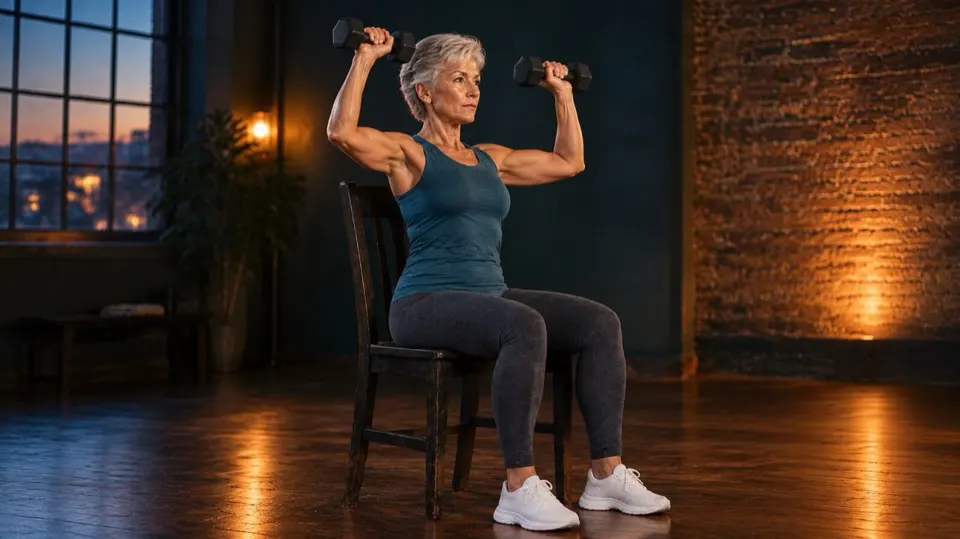
Seated overhead press
Shoulders & arms- Sit tall holding light dumbbells or water bottles at shoulder height.
- Press them overhead until your arms are almost straight.
- Lower slowly to your shoulders.
- How much
- 2–3 sets of 8–12
- Easier
- Press one arm at a time, or without weight.
- Harder
- Stand up to press.
- 6
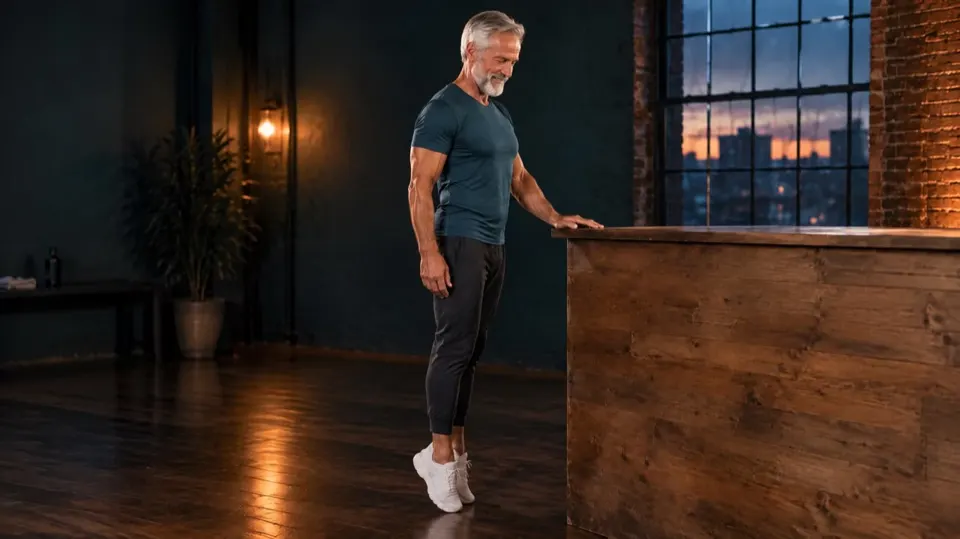
Standing heel raise
Calves & ankles- Stand behind a chair holding the back.
- Rise up onto your toes as high as you can.
- Lower slowly.
- How much
- 2–3 sets of 10–15
- Easier
- Do it seated.
- Harder
- Hold for 3 seconds at the top, or hold on with one hand.
- 7
Side leg raise
Hips & balance- Stand behind a chair holding the back.
- Lift one leg out to the side, keeping your body upright and toes facing forward.
- Lower slowly. Do all reps, then switch legs.
- How much
- 2 sets of 10 each leg
- Easier
- Make the lift smaller.
- Harder
- Add a light ankle weight.
- 8
Farmer carry
Grip, core & posture- Hold a light dumbbell or a full shopping bag in each hand.
- Walk tall around the room for 30–60 seconds.
- Put them down by bending your knees, back straight.
- How much
- 2–3 carries
- Easier
- Carry one weight and keep a hand free for support.
- Harder
- Use heavier weights.
The routine
Rest for about a minute between sets. Use the support options whenever you need them.
| Part | Exercises | Time |
|---|---|---|
| Warm-up | Marching on the spot, arm circles, heel raises | 4 min |
| Legs | Sit to stand, step-up, side leg raise | 7 min |
| Upper body | Wall push-up, band row, seated overhead press | 6 min |
| Finish | Farmer carry, gentle stretches | 3 min |
How often
The World Health Organization recommends that adults aged 65 and over do muscle-strengthening activities on at least two days a week, plus activities that focus on balance and strength on three or more days.
Aim for two or three strength sessions a week with a rest day between. When you can do 12 reps comfortably, add a little weight or try the harder version.
Want a plan that does this for you?
Train at Home builds strength plans for older adults, including Chair Fitness for Older Adults, Chair Strength and Fully Seated Strength, and adapts every move to your answers about balance, joints and health.
Coming soon to theApp StoreFrequently asked questions
Is strength training safe for seniors?
For most older adults, yes, and it is strongly recommended. Start light, use support for balance, and check with your doctor first if you have a heart condition, osteoporosis or a recent injury.
How often should seniors do strength training?
At least two days a week, according to World Health Organization guidelines, ideally with a rest day between sessions.
Is it too late to build muscle at 70 or 80?
No. Studies show that people in their 70s, 80s and beyond can still gain strength with regular training.
Do I need weights?
Not at first. Body weight, a chair and a wall are enough. Light dumbbells, water bottles or a resistance band help you keep progressing.
Sources
- World Health Organization: Physical activity fact sheet
- CDC: Physical activity guidelines for older adults
- NHS: Physical activity guidelines for older adults
- National Institute on Aging: Types of exercise for older adults
- Arthritis Foundation: Exercise and strength training with arthritis
This guide is general information, not medical advice. Talk to your doctor or a physiotherapist before starting a new exercise programme, especially if you have a health condition.