Calisthenics for beginners
Nine bodyweight exercises with clear progressions, from incline push-ups to your first pull-up, and a simple three-day plan you can start today.
Why it works
Calisthenics means training with your own body weight. It builds real strength, control and endurance, needs little or no equipment, and every exercise has a version that fits your level today.
The key is progression: start with an easier version, master it, then move to the next step. That is how a wall push-up becomes a full push-up, and a dead hang becomes a pull-up.
Safety first
- Warm up for a few minutes first with marching, arm circles and easy squats.
- Use a stable chair against a wall for dips. Never use a chair with wheels.
- If you use a pull-up bar, check it is fitted firmly before you hang from it.
- Stop a set when your form breaks down, and stop if you feel sharp or joint pain.
The 9 exercises
- 1
Push-up
Chest, shoulders & triceps- Place your hands slightly wider than your shoulders.
- Hold a straight line from head to heels and lower your chest towards the floor.
- Push back up, keeping your elbows at about 45 degrees.
- How much
- 3 sets of 5–12
- Easier
- Push up from a wall, then a kitchen counter, then a sturdy chair seat.
- Harder
- Diamond push-ups or a slow 3-second lowering.
- 2
Bodyweight squat
Legs & glutes- Stand with feet shoulder-width apart, toes slightly out.
- Sit down and back, chest tall, as low as is comfortable.
- Stand up by pushing through your whole foot.
- How much
- 3 sets of 10–20
- Easier
- Squat to a chair.
- Harder
- Pause at the bottom or try split squats.
- 3
Reverse lunge
Legs & balance- Stand tall, then step one foot back.
- Lower until both knees bend to about 90 degrees.
- Push through your front foot to stand. Alternate legs.
- How much
- 3 sets of 8 each leg
- Easier
- Hold a chair for balance and take a shorter step.
- Harder
- Add a knee drive at the top.
- 4
Glute bridge
Glutes & hamstrings- Lie on your back, knees bent, feet flat.
- Press through your heels and lift your hips until your body forms a straight line from shoulders to knees.
- Squeeze at the top, then lower.
- How much
- 3 sets of 12–15
- Easier
- Lift halfway.
- Harder
- Single-leg bridge.
- 5
Chair dip
Triceps & shoulders- Sit on the edge of a stable chair with hands beside your hips.
- Slide forward and bend your elbows to lower your body a few inches.
- Press back up until your arms are straight.
- How much
- 3 sets of 6–10
- Easier
- Keep your knees bent and feet close.
- Harder
- Straighten your legs.
- 6
Forearm plank
Core- Rest on your forearms, elbows under shoulders.
- Step back into a straight line from head to heels.
- Hold while breathing steadily.
- How much
- 3 holds of 20–45 seconds
- Easier
- Drop to your knees.
- Harder
- Lift alternate feet, or hold longer.
- 7
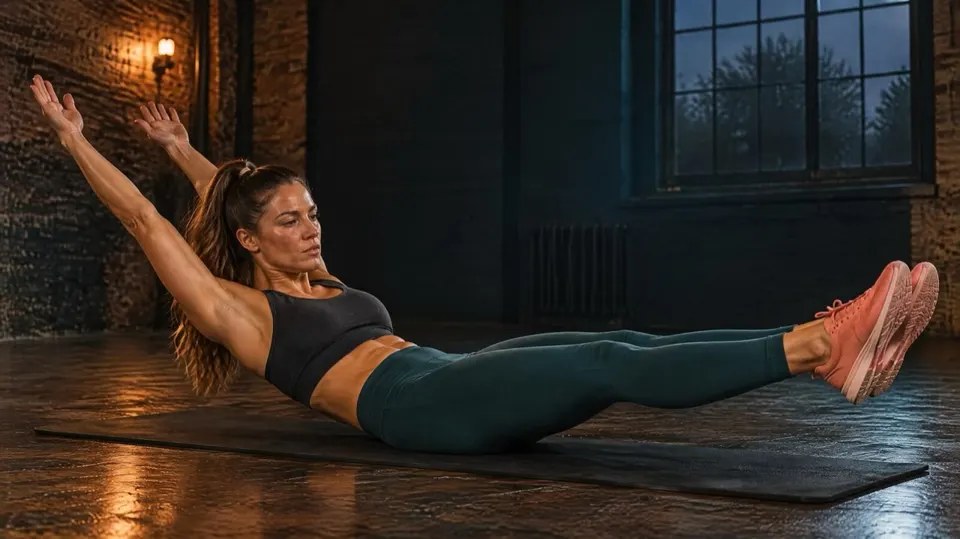
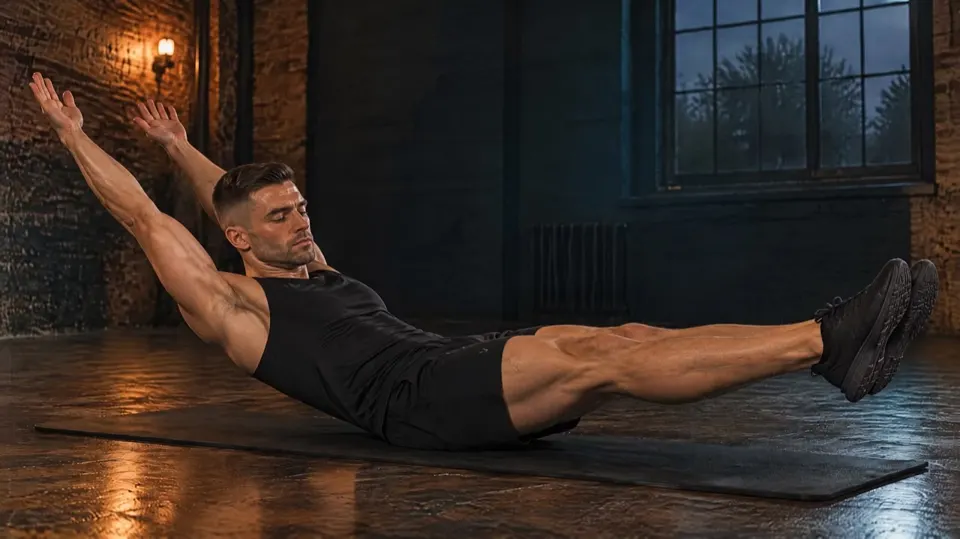
Hollow hold
Deep core- Lie on your back and press your lower back into the floor.
- Lift your shoulders and legs a little off the floor, arms by your sides.
- Hold, keeping your lower back down.
- How much
- 3 holds of 10–30 seconds
- Easier
- Keep your knees bent (tuck hold).
- Harder
- Reach your arms overhead.
- 8
Superman
Back & posture- Lie on your front, arms reaching forward.
- Lift your arms, chest and legs a few inches, neck long.
- Hold for 2 seconds and lower.
- How much
- 3 sets of 10
- Easier
- Lift only your arms, then only your legs.
- Harder
- Hold each rep for 5 seconds.
- 9
Dead hang & scapular pull
Grip, back & first pull-up- Hang from a secure pull-up bar with straight arms.
- Without bending your elbows, pull your shoulders down away from your ears, lifting yourself an inch.
- Lower with control.
- How much
- 3 sets of 5–8 pulls, or 20–30 second hangs
- Easier
- Keep your feet on a step to take some weight.
- Harder
- Slow negative pull-ups: start at the top and lower over 3–5 seconds.
The routine
Do this full-body session three times a week. Rest about 60 seconds between sets.
| Part | Exercises | Time |
|---|---|---|
| Warm-up | Marching, arm circles, easy squats | 4 min |
| Push | Push-up (your level), chair dip | 6 min |
| Legs | Squat, reverse lunge, glute bridge | 8 min |
| Core & pull | Plank, hollow hold, superman, dead hang (if you have a bar) | 7 min |
How often
Three full-body sessions a week, for example Monday, Wednesday and Friday, works well for beginners.
When you can do the top of the rep range for all sets, move to the next progression of that exercise.
Want a plan that does this for you?
Train at Home includes Beginner Calisthenics, a Push-Up Starter to Push-Up Mastery progression, Pull-Up Bar Strength and military-style circuits, and adjusts each move to your level.
Coming soon to theApp StoreFrequently asked questions
Can a complete beginner do calisthenics?
Yes. Every calisthenics exercise has an easier version, such as wall push-ups or squats to a chair, so you can start at any fitness level.
Do I need a pull-up bar?
No. You can build a strong base without one. A bar adds pulling exercises for your back, which balances out all the pushing.
How long does it take to do a first pull-up?
It varies widely. With regular hangs, scapular pulls and slow negatives two or three times a week, many people get there within a few months.
Can you build muscle with calisthenics?
Yes, as long as you keep making exercises harder over time, the same principle as lifting weights.
Sources
This guide is general information, not medical advice. Talk to your doctor or a physiotherapist before starting a new exercise programme, especially if you have a health condition.